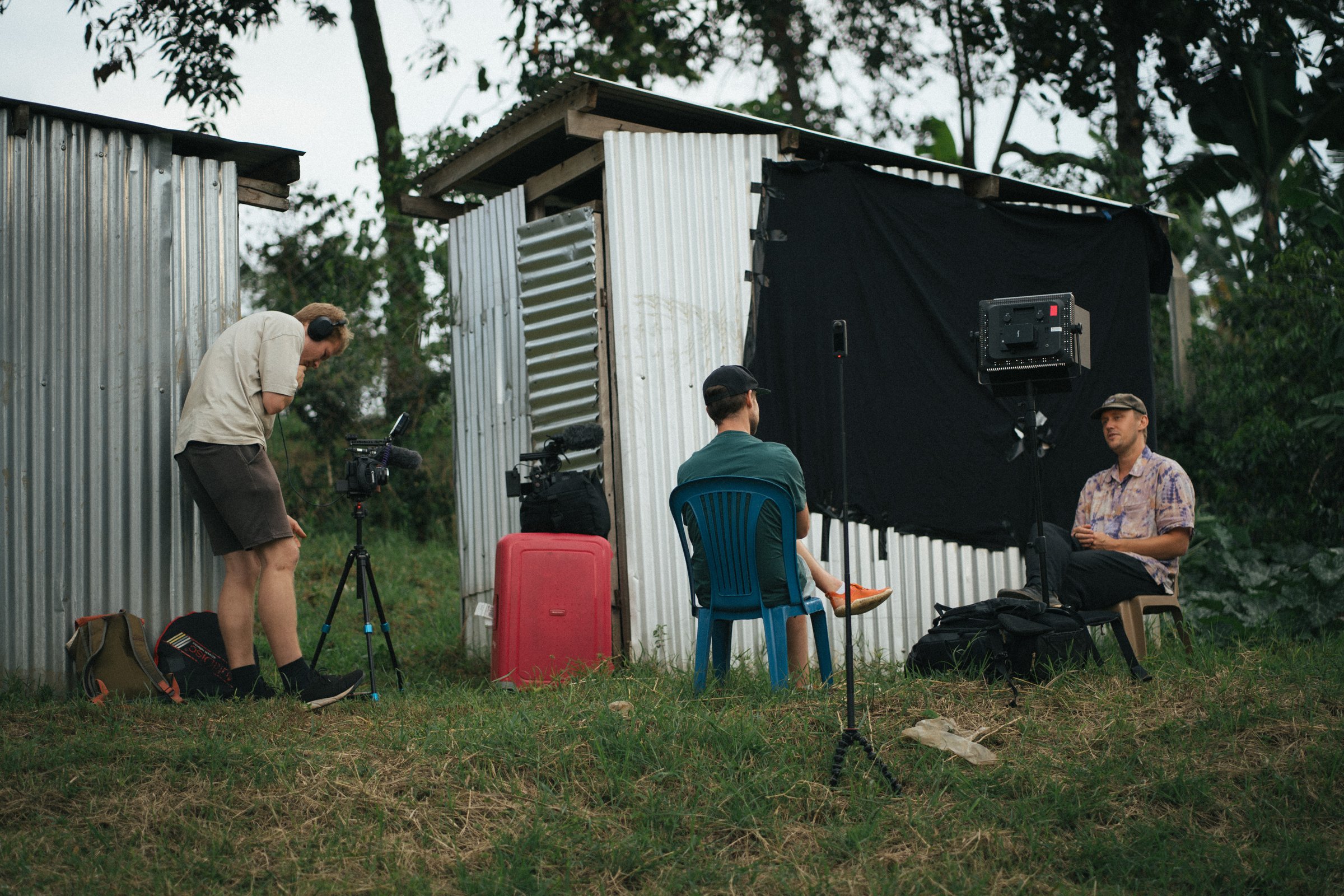
The people closest to the work see it least clearly. That isn’t strange. What you do every day has become ordinary, and ordinary rarely feels like a story.
You are too close to see it, and that’s normal
I have talked to people in Indonesia, Uganda and Thailand who say they would love to see Sweden one day. I usually tell them to come in the summer, because the winters are horrible. The answer is almost always the same: “I’ve never seen snow. That sounds amazing.”
What I take for granted is exotic to someone else. It is the same in a company. What you have got used to, the routines, the decision no outsider understands, the reason the company exists, may be exactly what someone else wants to see. In Swedish we call it being hemmablind: blind to your own home.
The story is rarely the one you expect
In our cases, it was seldom the obvious thing that carried the story:
- Fjällnäs is Sweden’s oldest high-mountain hotel. But the film isn’t about the hotel. It is about Lars and Kina Bertmar, who own it, and the life that made the place what it is.
- Fortum built a fish passage for about 400 million kronor. What made people understand it was that, at Spjutmo, it had to be built in levels, like a parking garage.
- Candela builds electric boats that fly on hydrofoils. One of the strongest details was that the first prototype ran on a flight controller one of the engineers had written for a drone.
None of those details are in a press release. They come up when you keep asking.
Talk to the people who do the work
Usually the CEO and the marketing team have one thing they want to push. But when you start interviewing the people who actually do the work, perspectives come up that turn out to be what carries the story, and what proves it.
Those perspectives can almost never be planned for. You only find them by going out and talking to other people than the ones who commissioned the film.
Questions to ask yourselves
Set aside an afternoon and talk through these questions. Answer the way you would answer a friend, not the way your website does. And don’t only ask them in the management team.
- Why did the company really start?
- What frustrates you about your industry?
- What have you seen that most people never get to see?
- What is changing right now, and why does it matter?
- Who, in or around your company, could carry a story? It isn’t always the CEO. It could be a customer, a partner, or someone affected by what you do.
- Should the company be the main character at all?
Signs that you have found something
The strongest signal is when something feels uncomfortable. When someone says “we can’t tell that”, it is usually exactly what someone else finds interesting. What feels uncomfortable to show is often what makes a story feel true.
Other signs:
- Something is changing. A story needs movement.
- Something is at stake. There is an outcome that isn’t given.
- There is a person others listen to.
- It can’t be recreated later. What is happening right now will never look quite the same again.
When it is time to get help from outside
Sometimes an afternoon is enough. Sometimes you know the work matters, but still can’t see where the story is. Then it helps to have someone from outside ask the questions.
That is what Story discovery is for. We start with two hours with the people closest to the work. Then we go through your material, do a few short interviews and look at the world around you. After two to three weeks you get a Story Map: the central question, possible main characters, the tension, the key moments, the access needed and the format that fits.
Story discovery costs 1,100 EUR. It is credited in full if you go on to make the film with us, and the Story Map is yours to use however you like.
Want to talk about what might be there in your company? Book a free 30-minute call.