
Most branded documentaries fail before filming starts
Not because the cinematography is bad. Not because the story isn't important. And not because the filmmaker lacks talent.
They fail because the structure is broken from the beginning.
I started Impact Docs because I believe that documentaries funded by companies could be one of the most useful tools we have for educating people, at scale, about how the world actually works.
About the systems behind the things we consume.
About the people growing our food, the ecosystems we depend on, the futures we're either protecting or quietly dismantling.
There's real money in branded film, and that money could fund storytelling that matters.
But that's not what I see being made. Most of what I see is beautiful. Cinematically polished. Emotionally scored. And underneath, the only real goal is to sell more of something. The story is shaped backwards from a campaign objective, and the audience is meant to leave feeling good about a purchase rather than thinking about their choices.
And yes, I've made films like that. Not deliberately or cynically, but because the structure of how these projects usually get made is built like that.
That's the thing I've been trying to figure out how to change. Not by lecturing brands, not by changing the ingredients of the films, but by experimenting with who brings what to the table.
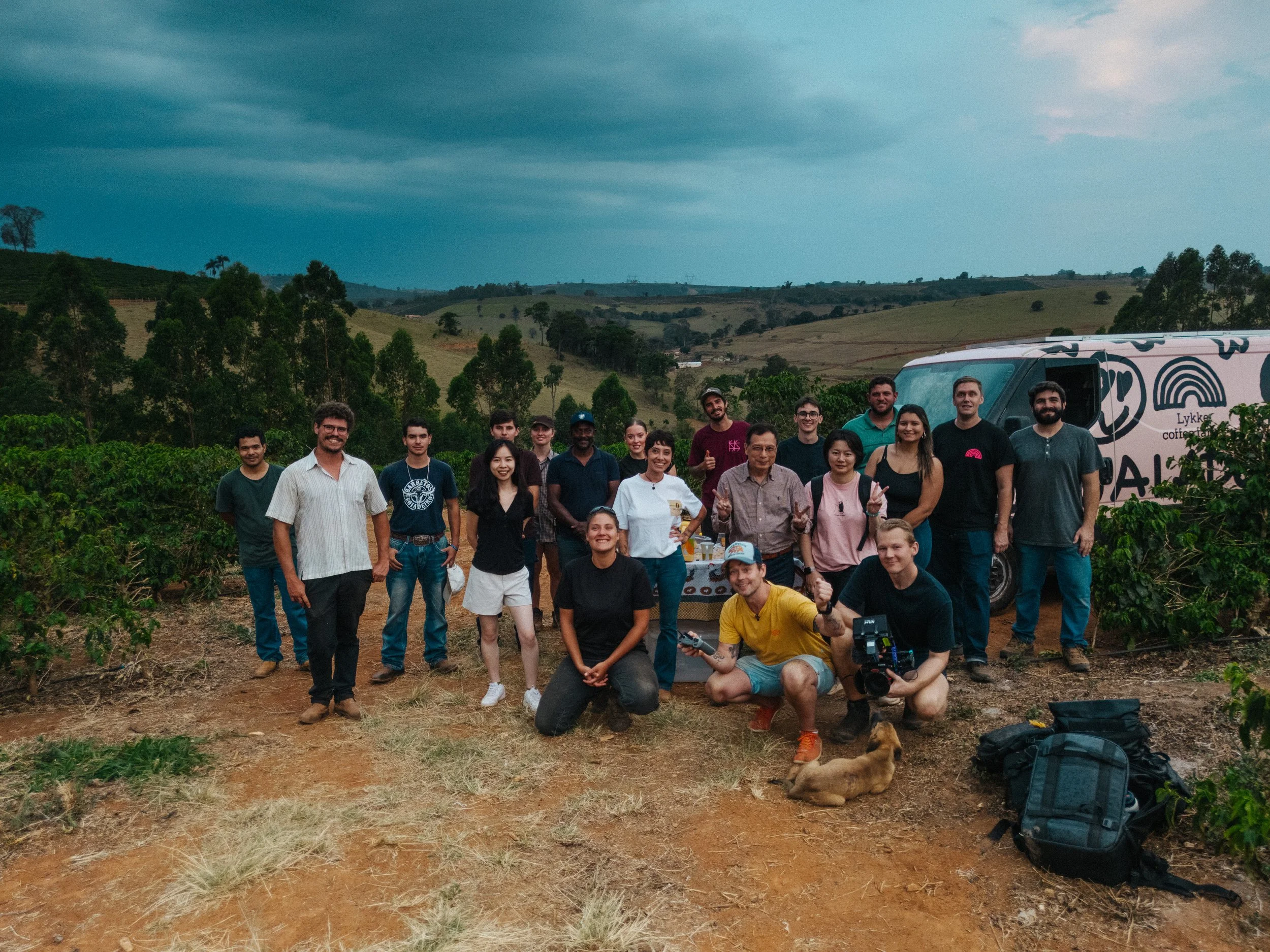
On site in Brazil. We met so many incredible farmers.
The brand wants to play every position
Very simplified, a documentary film needs three things to become reality.
Story — A character who is going through something.
Financing — Someone is paying for it to exist.
Distribution — Where and how it reaches an audience. The channel.
I call that The Holy Trinity of Documentary. It’s cheesy, I know.
Branded projects usually start either by a filmmaker having an idea for a story and approaching a brand, or a brand having a need for a film to be made, approaching a filmmaker.
Either way, the brand is usually the one paying for it to happen.
And since the brand is paying for it, it’s only natural that it inserts itself into all three of the roles. Of course they want to control the story and have it published in their own channels, right?
This is where it usually goes wrong.
The brand wants authenticity, but also control over the narrative and have final say on the outcome.
The filmmaker wants honesty and freedom to explore the story, but also continued access to locations and the relevant people, so they avoid pushing back to protect the story.
The audience wants reality, and their bullshit detector is fine-tuned to ignore anything that feels like it was decided beforehand.
This is a brilliant recipe for something that looks cinematic on the surface but feels hollow underneath. You can sense it.
I've been thinking about this a lot while finishing the Brazil coffee film we shot with Lykke Coffee Farms last year. And how them being brave, completely solved all of that.
An unusual setup in Brazil
Lykke brought me and Isak to Brazil because they wanted documentary style films about the projects they run in Brazil to improve the lives and livelihood of the coffee farmers.
At the same time, I was making a documentary film for my YouTube project, exploring a much larger question that had started following me after filming a coffee documentary in Uganda (also with Lykke) the year before:
What actually happens to coffee when the ways we're growing it stop working?
Instead of forcing Lykke’s and my goals together into one branded narrative, this time both perspectives were allowed to exist independently. We spent one week filming on coffee farms in Brazil, and since the stories were closely related we could easily cover everything we needed in that time.
So for this production, the Holy Trinity looked like this:
Story: Felipe, their partner in Brazil, carries the story because he's the one living inside these questions every day.
Financing: Lykke enabled the project financially and logistically.
Distribution: My channel becomes the place where the long form documentary can live and be shared with a curious audience.
That separation, I think, is the whole thing.
What it actually looked like
In practice it was simpler than it sounds. Lykke briefed us about their two films and would of course see and approve them before release. Just like any client commissioned film process goes.
The film for my channel was financed in part by the same trip, using the same footage and interviews, but where the story was mine to tell.
That took one conversation to agree on. What it required from Lykke wasn't a more complicated process.
It was a willingness to trust that an honest film about coffee's future would reflect well on a company genuinely engaged with that future.
That's the part most brands struggle with. Not the logistics. The leap into uncertainty.
Why the audience can tell
The easiest way to kill trust in documentary storytelling is when all three roles in the triangle merge.
The brand becomes the storyteller. The storyteller becomes the advertiser. The subject becomes proof of the message.
Once that happens, audiences stop watching openly. You know the feeling. Every emotional moment becomes suspect, because people feel that it was decided before filming began.
That's why so much branded storytelling ends up feeling cinematographically polished and completely forgettable at the same time.
Nobody fully controls the outcome
Real documentary storytelling requires uncertainty. You have to let the filmmaker follow tension wherever it leads, even when the implications become bigger, stranger, or less commercially convenient than expected.
In Brazil, it started as a story about coffee, but gradually became something much larger. About climate, systems, long-term thinking, and what it takes for humans to change.
That is not a particularly safe place for a brand to stand. Unsafe requires courage. And confidence that what you do is so good, that it will appear good when you let someone from the outside explore it.
And I think that's exactly why this collaboration worked.
Lykke never seemed interested in forcing themselves into the center of the narrative. They understood something most companies still struggle with: audiences trust curiosity more than control.
The moment a company becomes overly concerned with protecting the message, the story stops feeling interesting.
What this could look like for more brands
I think more brands should pay attention to this kind of structure, because it produces something fundamentally different from traditional branded content.
Instead of the company trying to own the entire narrative, the brand becomes the enabler of a real exploration. The filmmaker protects curiosity. The subject protects truth. The audience gets to observe the tension instead of being pushed toward a predetermined conclusion.
The first useful question for a brand isn't what film do we want to make? It's which of the three roles do we actually want to play? Most companies instinctively reach for all three. The ones who get the most out of this kind of work usually pick one: financing and providing access. And let the other two belong to people whose job it is to protect them.
Ironically, giving up some control often creates far more trust than trying to maintain all of it.
And I suspect that's where documentary storytelling for brands becomes genuinely interesting.
If something here resonated, the easiest next step is a 30-minute call. No pitch — just a conversation about whether this approach fits what you're trying to do.